Description
- Background: Heparin-binding EGF-like growth factor (HBEGF) is a member of the EGF family, acting as a key mediator of cell proliferation, differentiation, and survival via binding to EGFR/ErbB receptors. In the nervous system, HBEGF plays multifaceted roles: it promotes neurogenesis and neurite outgrowth during development, supports synaptic plasticity and maintenance in adulthood, and participates in neuroprotective responses to injury by regulating glial cell activation and tissue repair. Dysregulation of HBEGF is linked to neurological disorders, including Alzheimer’s disease (via abnormal EGFR signaling) and ischemic stroke (where its upregulation modulates blood-brain barrier integrity and inflammation). Its dual function as a trophic factor and injury-responsive mediator makes HBEGF a potential target for neuroprotective and regenerative therapies.
- Gene editing strategy: The exons 2~4 of mouse Hbegf gene that encode the extracellular domain were replaced by human HBEGF exons 2~4 in B-hHBEGF mice.
- Validation:
- Mouse Hbegf mRNA were detectable in heart and lung of wild-type C57BL/6N mice. Human HBEGF mRNA were detectable in B-hHBEGF mice, and confirmed via Sanger Sequencing.
- Pro-HBEGF and soluble HBEGF (sHBEGF) were detected in brain, lung, kidney, liver and spleen by western blotting. Human sHBEGF was detectable in homozygous B-hHBEGF mice by ELISA.
- Application: B-hHBEGF mice can be utilized for both efficacy evaluation and safety assessment of pharmaceutical agents.
Targeting strategy
Gene targeting strategy for B-hHBEGF mice. The exons 2~4 of mouse Hbegf gene that encode the extracellular domain were replaced by human HBEGF exons 2~4 in B-hHBEGF mice.
mRNA expression analysis
Strain specific analysis of HBEGF mRNA expression in wild-type C57BL/6N mice and B-hHBEGF mice by RT-PCR. Heart and lung RNA were isolated from wild-type C57BL/6N mice (+/+) and homozygous B-hHBEGF mice (H/H), then cDNA libraries were synthesized by reverse transcription, followed by PCR with mouse and human HBEGF primers. As the coding region is only about 630bp, the same primers were used to amplify both mouse Hbegf and human HBEGF gene. PCR products in heart and lung for human HBEGF were confirmed via Sanger Sequencing.
Protein expression analysis
Western blot analysis of HBEGF protein expression in homozygous B-hHBEGF mice. Various tissue lysates were collected from wild-type C57BL/6N (+/+) mice and homozygous B-hHBEGF mice (H/H), and then analyzed by western blot with species-specific anti-HBEGF antibody. 40 μg total proteins were loaded for western blotting analysis. Pro-HBEGF and soluble HBEGF (sHBEGF) were detected in brain, lung, kidney, liver and spleen. The antibodies showed cross-recognition between human and mouse.
sHBEGF Protein Expression Analysis
Protein expression analysis of human HBEGF in homozygous B-hHBEGF mice by ELISA. Various tissue homogenates were collected from wild-type C57BL/6N mice (male, n=3, 7-week-old) and homozygous B-hHBEGF mice (male, n=3, 7-week-old). Protein expression level of human HBEGF was analyzed by ELISA with anti-human HBEGF antibody (R&D, DHBEG0). This ELISA kit has less cross-reactivity with mouse HBEGF. Human sHBEGF was detectable in homozygous B-hHBEGF mice.
Protein Expression Analysis of TFR1
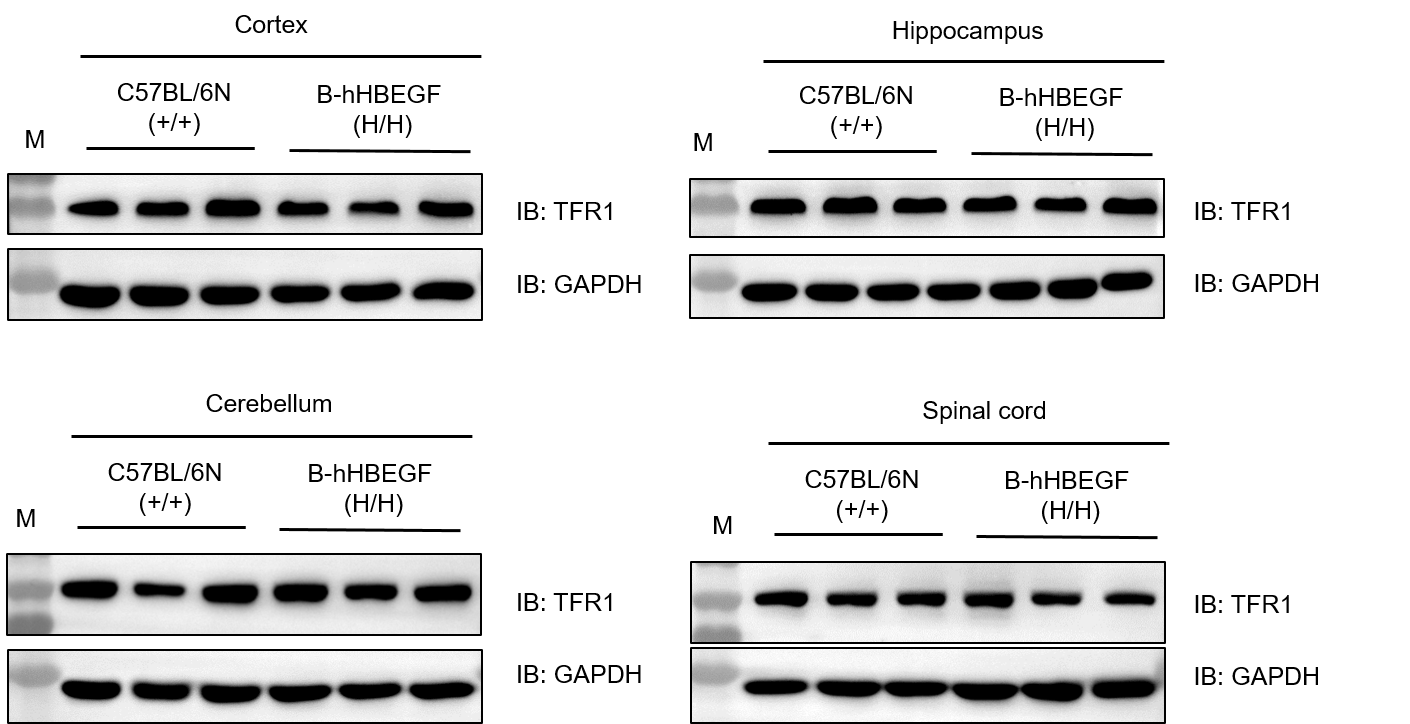
Western blot analysis of TFR1 protein expression in homozygous B-hHBEGF mice. Various tissue lysates were collected from wild-type C57BL/6N mice (+/+) and homozygous B-hHBEGF mice (H/H), and then analyzed by western blot with anti-human TFR1 antibody (Abcam, ab214039). 40 μg total proteins were loaded for western blotting analysis. Human TFR1 was detected in cortex, hippocampus, cerebellum and spinal cord from homozygous B-hHBEGF mice and wild-type C57BL/6N mice.
* When publishing results obtained using this animal model, please acknowledge the source as follows: The animal model [B-hHBEGF mice] (Cat# 111089) was purchased from Biocytogen.