德晋贵宾厅

B-hTFR1/hIL1B mice

C57BL/6-Tfrctm1(TFRC)Bcgen Il1btm1(ILIB)Bcgen/Bcgen • 113689

B-hTFR1/hIL1B mice

Product nameB-hTFR1/hIL1B mice
Catalog number113689
Strain nameC57BL/6-Tfrctm1(TFRC)Bcgen Il1btm1(ILIB)Bcgen/Bcgen
Strain backgroundC57BL/6
NCBI gene ID7037,3553 (Human)
AliasesT9; TR; TFR; p90; CD71; TFR1; TRFR; IMD46; IL-1; IL1F2; IL1beta; IL1-BETA

在此页面上

  • Description
  • Targeting strategy
  • Phenotypic analysis

海报

查看全部

    发表文章

      Description

      Background:

      • TFR1, a membrane protein expressed across various cell and tissue types in the human body, plays a crucial role in facilitating iron transport and metabolism. TFR1 is markedly expressed in numerous types of cancer cells. Studies have demonstrated that targeting TFR1 can effectively suppress tumor growth and metastasis. Moreover, TFR1 is also implicated in other conditions such as anemia and neurodegenerative disorders, etc.
      • IL-1β is a key pro-inflammatory cytokine; in MS it activates microglia, stabilizes Th17 cells, disrupts the blood-brain barrier and recruits leukocytes, thereby initiating and amplifying inflammatory demyelinating relapses.
      • Given its high expression of TFR1 on brain endothelial cells and muscle cells, TFR1 can be leveraged as a receptor for receptor-mediated transcytosis (RMT), which allows for the efficient transport of large molecules across the BBB and muscle.

      Targeting strategy:

      • The exons 4-19 of mouse Tfr1 gene that encode extracellular domains are replaced by human counterparts in B-hTFR1/hIL1B mice.
      • The exons 2-7 of mouse Il1b gene that encode the entire mature IL1B domains are replaced by human counterparts in B-hTFR1/hIL1B mice.

      Validation:

      • TFR1 was detected in B-hTFR1/hIL1B mice and wild-type C57BL/6 mice, as the antibody was cross-reactive between human and mouse.
      • Mouse IL1B was only detectable in wild-type C57BL/6 mice. Human IL1B was exclusively detectable in homozygous B-hTFR1/hIL1B mice.
      • Humanization of TFR1 and IL1B does not change the overall frequency or distribution of immune cell types in spleen, blood and lymph nodes.

      Application:

      • This product is used to evaluate the pharmacodynamics and safety of treatments for multiple sclerosis, as well as to assess the potential of drugs to penetrate the blood-brain barrier.
      Targeting Strategy

      Gene targeting strategy for B-hTFR1 mice.

      • The exons 4-19 of mouse Tfr1 gene that encode extracellular domain are replaced by human counterparts in B-hTFR1 mice. The genomic region of mouse Tfr1 gene that encodes cytoplasmic portion is retained. The promoter, 5’UTR and 3’UTR regions of the mouse gene are also retained. The chimeric TFR1 expression is driven by endogenous mouse Tfr1 promoter, while mouse Tfr1 gene transcription and translation will be disrupted.

      Gene targeting strategy for B-hIL1B mice.

      • The exons 2-7 of mouse Il1b gene that encode the entire mature IL1B domains are replaced by human counterparts in B-hIL1B mice. The promoter, 5’UTR and 3’UTR regions of the mouse gene are retained. The human IL1B expression is driven by endogenous mouse Il1b promoter, while mouse Il1b gene transcription and translation will be disrupted.
      Protein Expression Analysis of TFR1

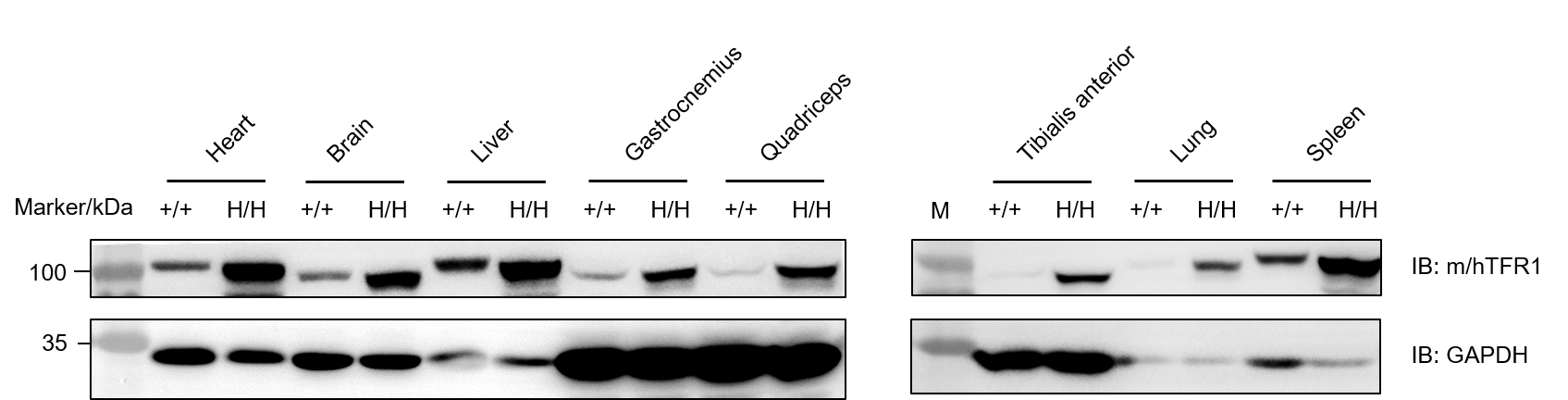
      Western blot analysis of TFR1 protein expression in homozygous B-hTFR1/hIL1B mice. Various tissue lysates were collected from wild-type C57BL/6 mice (+/+) and homozygous B-hTFR1/hIL1B mice (H/H), and then analyzed by western blot with anti-TFR1 antibody (ab214039; abcam). 40 μg total proteins were loaded for western blotting analysis. TFR1 was detected in B-hTFR1/hIL1B mice and wild-type C57BL/6 mice, as the antibody was cross-reactive between human and mouse.

      Protein Expression Analysis of IL1B

      Strain specific IL1B expression analysis in wild-type C57BL/6JNifdc mice and homozygous humanized B-hTFR1/hIL1B mice by ELISA. Bone marrow cells were collected from wild-type C57BL/6JNifdc mice (+/+) (female, n=3, 8-week-old) and homozygous B-hTFR1/hIL1B mice (H/H) (female, n=3, 8-week-old) add 1 mL of complete medium containing 40 ng/mL mouse GM-CSF (PeproTech, 315-03-50μg) and 20 ng/mL mouse IL-4 (SinoBiological, 51084-MNAE). Cultivate for 6 days to allow the cells to differentiate into DC cells and then stimulated with 1 mg/mL LPS for 16 hrs on day 6. Expression level of mouse and human IL1B were analyzed by ELISA (anti-mouse IL1B ELISA kit: abcam, ab197742; anti-human IL1B ELISA kit: abcam, ab214025). Mouse IL1B was only detectable in wild-type C57BL/6 mice. Human IL1B was exclusively detectable in homozygous B-hTFR1/hIL1B mice. Values are expressed as mean ± SEM.
      Frequency of Leukocyte Subpopulations in Spleen

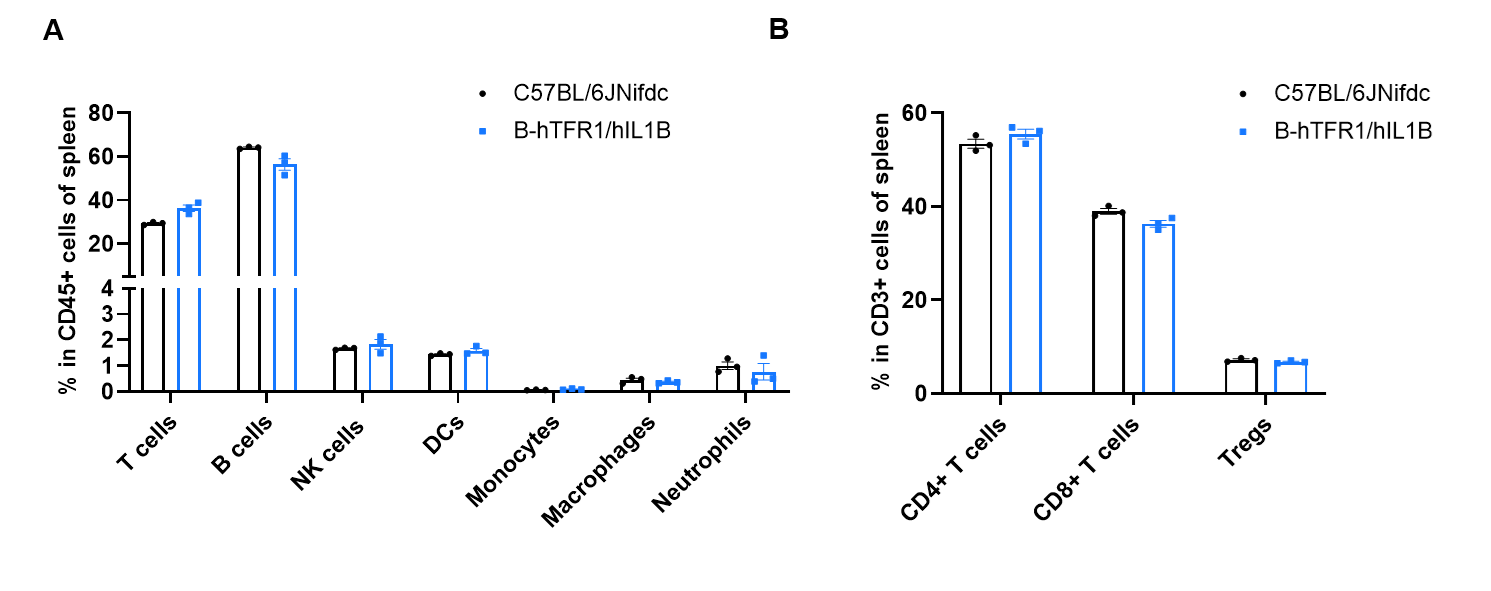
      Frequency of leukocyte subpopulations in spleen by flow cytometry. Splenocytes were isolated from wild-type C57BL/6JNifdc mice (female, n=3, 8-week-old) and homozygous B-hTFR1/hIL1B mice (female, n=3, 8-week-old). A. Flow cytometry analysis of the splenocytes was performed to assess the frequency of leukocyte subpopulations. B. Frequency of T cell subpopulations. Percentages of T cells, B cells, NK cells, DCs, neutrophils, monocytes, macrophages, CD4+T cells, CD8+T cells and Tregs in B-hTFR1/hIL1B mice were similar to those in C57BL/6JNifdc mice. Humanization of TFR1 and IL1B does not change the overall frequency or distribution of immune cell types in spleen. The frequency of leukocyte subpopulations in lymph nodes and blood of B-hTFR1/hIL1B mice were also comparable to wild-type C57BL/6JNifdc mice (data not shown). Values are expressed as mean ± SEM. Significance was determined by two-way ANOVA test.  *p < 0.05, **p < 0.01, ***p < 0.001.

      * When publishing results obtained using this animal model, please acknowledge the source as follows: The animal model [B-hTFR1/hIL1B mice] (Cat# 113689) was purchased from Biocytogen.