
NOD.CB17-Prkdcscid Il2rgtm1Bcgen Il15tm1(IL15)Bcgen Fcgr2btm1Bcgen Fcgr4tm1Bcgen Fcgr3tm1Bcgen Fcgr1tm1Bcgen/Bcgen • 114234
| Product name | huPBMC-B-NDG hIL15, FcγR KO mice |
|---|---|
| Catalog number | 114234 |
| Strain name | NOD.CB17-Prkdcscid Il2rgtm1Bcgen Il15tm1(IL15)Bcgen Fcgr2btm1Bcgen Fcgr4tm1Bcgen Fcgr3tm1Bcgen Fcgr1tm1Bcgen/Bcgen |
| Strain background | B-NDG |
| NCBI gene ID | 19090,16186,16168,14129,14130,246256 (Mouse) |
| Aliases | p460; scid; slip; DNAPK; DNPK1; HYRC1; XRCC7; dxnph; DOXNPH; DNAPDcs; DNA-PKcs; gc; p64; [g]c; CD132; gamma(c); IL-15; CD64; IGGHAFC; FcgammaRI; CD32; Fcgr2; Fcr-2; Fcr-3; Ly-17; LyM-1; Lym-1; fcRII; FcgRII; Fcgr2a; Ly-m20; Fc[g]RII; F630109E10Rik; Fcrl3; CD16-2; FcgRIV; Fcgr3a; FcgammaRIV; 4833442P21Rik |


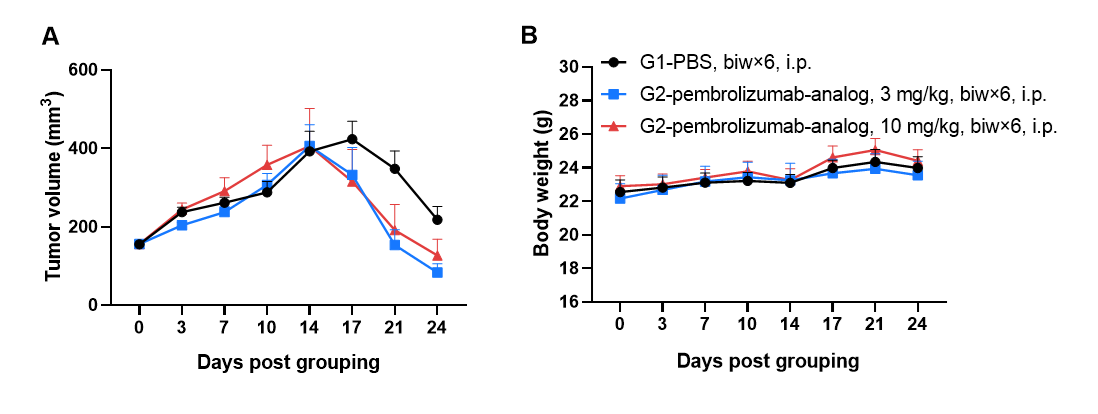
Antitumor activity of anti-human PD-1 antibody pembrolizumab analog (in-house) in lung adenocarcinoma cell line HCC827 CDX model established with huPBMC-B-NDG hIL15, FcγR KO mice. HCC-827 cells (1.5×10⁷) were subcutaneously inoculated into B-NDG hIL15, FcγR KO mice. Mice were grouped when the tumor volume reached approximately 150 mm3, at which time they were intravenously engrafted human PBMCs (5×10⁶) and treated intraperitoneally with pembrolizumab analog with doses and schedule indicated in panel (female, 7-week-old, n=6). The results showed that pembrolizumab analog could effectively inhibit tumor growth in lung cancer CDX model established with huPBMC-B-NDG hIL15, FcγR KO mice. Values are expressed as mean ± SEM.
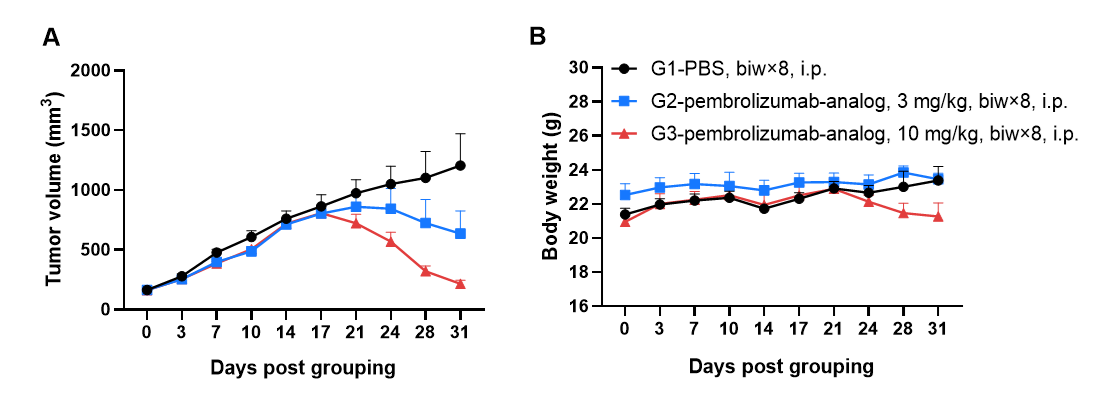
Antitumor activity of anti-human PD-1 antibody pembrolizumab analog (in-house) in non-small cell lung cancer cell line NCI-H1975 CDX model established with huPBMC-B-NDG hIL15, FcγR KO mice. NCI-H1975 cells (6×10⁶) were subcutaneously inoculated into B-NDG hIL15, FcγR KO mice. Mice were grouped when the tumor volume reached approximately 100-150 mm3, at which time they were intravenously engrafted human PBMCs (5×10⁶) and treated intraperitoneally with pembrolizumab analog with doses and schedule indicated in panel (female, 7-week-old, n=6). The results showed that pembrolizumab analog could effectively inhibit tumor growth in a dose-dependent manner in the lung cancer CDX model established with huPBMC-B-NDG hIL15, FcγR KO mice. Values are expressed as mean ± SEM.
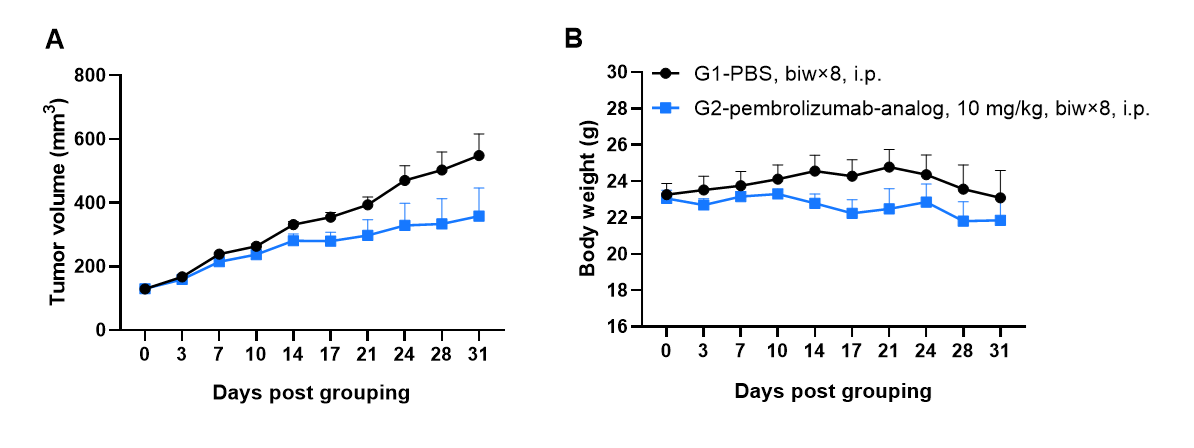
Antitumor activity of anti-human PD-1 antibody pembrolizumab analog (in-house) in breast cancer cell line MDA-MB-231 CDX model established with huPBMC-B-NDG hIL15, FcγR KO mice. Human PBMCs (5×10⁶) were intravenously engrafted into B-NDG hIL15, FcγR KO mice. On the same day, MDA-MB-231 cells (1×10⁷) were subcutaneously inoculated into B-NDG hIL15, FcγR KO mice. Mice were grouped when the tumor volume reached approximately 100-150 mm3, at which time they were treated intraperitoneally with pembrolizumab analog with doses and schedule indicated in panel (female, 7-week-old, n=6). The results showed that pembrolizumab analog could effectively inhibit tumor growth in the breast cancer CDX model established with huPBMC-B-NDG hIL15, FcγR KO mice. Values are expressed as mean ± SEM.