
C57BL/6-Ceacam5tm2(CEACAM5)Bcgen/Bcgen • 114278
| Product name | B-hCEACAM5 mice |
|---|---|
| Catalog number | 114278 |
| Strain name | C57BL/6-Ceacam5tm2(CEACAM5)Bcgen/Bcgen |
| Strain background | C57BL/6 |
| NCBI gene ID | 1048 (Human) |
| Aliases | CEA; CD66e |


Gene targeting strategy for B-hCEACAM5 mice. The full coding sequences of human CEACAM5 gene, including the promoter, 5’UTR and 3’UTR are inserted into mouse Hipp11 (H11) locus in B-hCEACAM5 mice.


Strain specific analysis of CEACAM5 mRNA expression in wild-type C57BL/6JNifdc mice and B-hCEACAM5 mice by RT-PCR. Colon RNA were isolated from wild-type C57BL/6JNifdc mice (+/+) and homozygous B-hCEACAM5 mice (H/H), then cDNA libraries were synthesized by reverse transcription, followed by PCR with human CEACAM5 primers. Human CEACAM5 mRNA was exclusively detectable in homozygous B-hCEACAM5 mice but not in wild-type mice.

Western blot analysis of CEACAM5 protein expression in homozygous B-hCEACAM5 mice. Various tissue lysates were collected from wild-type C57BL/6JNifdc mice (+/+) and homozygous B-hCEACAM5 mice (H/H), and then analyzed by western blot with anti-CEACAM5 antibody (Invitrogen, PA5-88533). 40 μg total proteins were loaded for western blotting analysis. Human CEACAM5 were detected in stomach, small intestine and colon tissues in homozygous mice but not wild-type C57BL/6JNifdc mice.

Strain specific CEACAM5 expression analysis in homozygous B-hCEACAM5 mice by flow cytometry. Colon was collected from wild-type C57BL/6JNifdc mice (+/+) and homozygous B-hCEACAM5 mice (H/H) and analyzed by flow cytometry with species-specific anti-human CD66a/c/e Antibody (Biolegend, 342308). Human CEACAM5 was exclusively detectable in colon of homozygous B-hCEACAM5 mice but not in wild-type mice.
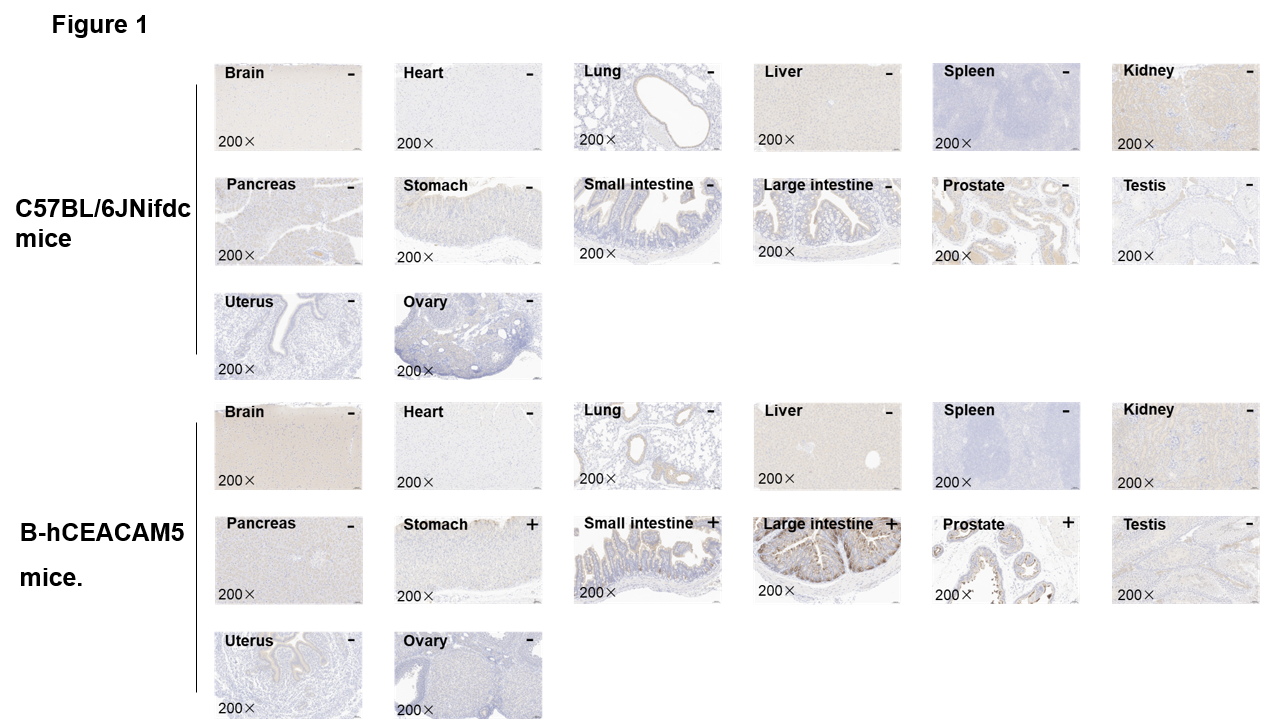
Immunohistochemical (IHC) analysis of CEACAM5 protein expression in wild-type mice and B-hCEACAM5 mice. Major tissues were collected from wild-type mice and homozygous B-hCEACAM5 mice and analyzed by IHC with anti-human CEACAM5 antibody (abcam, ab133633). Human CEACAM5 was detected in the stomach, small intestine, colon and prostate of B-hCEACAM5 mice (Figure 1).