
德晋贵宾厅

B-hALPG/hALPP mice

C57BL/6-Alppl2tm1(ALPP, ALPG)Bcgen/Bcgen • 113748

B-hALPG/hALPP mice

Product nameB-hALPG/hALPP mice
Catalog number113748
Strain nameC57BL/6-Alppl2tm1(ALPP, ALPG)Bcgen/Bcgen
Strain backgroundC57BL/6
NCBI gene ID251,250 (Human)
AliasesGCAP; ALPPL; ALPPL2; ALP; IAP; ALPI; PALP; PLAP; PLAP-1

在此页面上

  • Description
  • Targeting strategy
  • Phenotypic analysis

海报

查看全部

    发表文章

      Description
      • Background: ALPP (Alkaline Phosphatase, Placental) and ALPG (Alkaline Phosphatase, Germ Cell) are members of the human alkaline phosphatase gene family, encoding metalloenzymes that catalyze phosphoric acid monoester hydrolysis. ALPP is primarily expressed in placental and endometrial tissues during pregnancy, with its enzyme functioning as a homodimer dependent on magnesium and zinc ions. ALPG, also known as ALPPL2, shows minimal normal tissue expression except in placental trophoblasts but exhibits notable tumor specificity. Functionally, ALPP participates in mineral metabolism and placental development, while ALPG is linked to pluripotency maintenance as a naive-specific surface marker. Clinically, ALPP mutations may cause placental dysfunction, and its ectopic overexpression occurs in ovarian adenocarcinoma and serous cystadenocarcinoma. ALPG is highly expressed in seminomas (100%), ovarian cancers (60%), and mesotheliomas (43%), and its knockdown inhibits pancreatic cancer cell growth, making it a potential therapeutic target.
      • Targeting strategy: The exons 1-11 of mouse Alppl2 gene that encode whole protein domains are replaced by human ALPP and ALPG gene counterparts in B-hALPG/hALPP mice. The promoter, 5’UTR and 3’UTR regions of the mouse gene are also replaced with human counterparts. The mouse Alppl2 gene transcription and translation will be disrupted.

      • Validation: Human ALPG mRNA was detectable only in homozygous humanized B-hALPG/hALPP mice, but not in wild-type C57BL/6JNifdc mice, and human APLG sequences were confirmed by Sanger Sequencing. Human ALPG and ALPP protein were exclusively detectable in placenta from homozygous B-hALPG/hALPP mice, but not from wild-type C57BL/6JNifdc mice.
      • Application: This model can be used both to investigate the mechanisms of ALPP and ALPG-related diseases and to study ALPP or ALPG-targeted drug efficacy.
      Targeting Strategy

      Gene targeting strategy for B-hALPG/hALPP mice. The exons 1-11 of mouse Alppl2 gene that encode whole protein domains are replaced by human ALPP and ALPG gene counterparts in B-hALPG/hALPP mice. The promoter, 5’UTR and 3’UTR regions of the mouse gene are also replaced with human counterparts. The mouse Alppl2 gene transcription and translation will be disrupted.

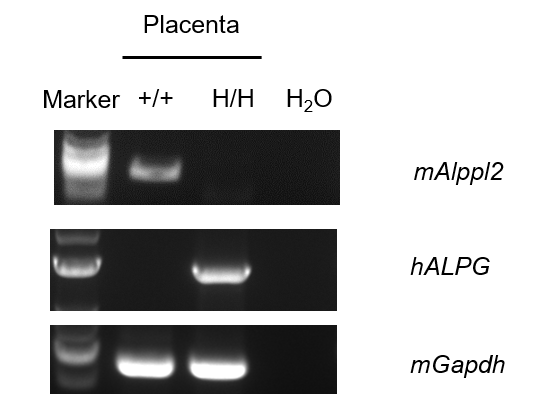
      mRNA Expression Analysis in Humanized B-hALPG/hALPP mice

      Species specific analysis of ALPG gene expression in wild-type C57BL/6JNifdc mice and homozygous humanized B-hALPG/hALPP mice by RT-PCR. Placenta tissues were collected from wild-type C57BL/6JNifdc mice (+/+) and homozygous humanized B-hALPG/hALPP mice (H/H), then cDNA libraries were synthesized by reverse transcription, followed by PCR with mouse Alppl2 or human ALPG primers. Mouse Alppl2 mRNA was only detectable in wild-type C57BL/6JNifdc mice. Human ALPG mRNA was detectable only in homozygous humanized B-hALPG/hALPP mice, but not in wild-type C57BL/6JNifdc mice, and human APLG sequences were confirmed by Sanger Sequencing.
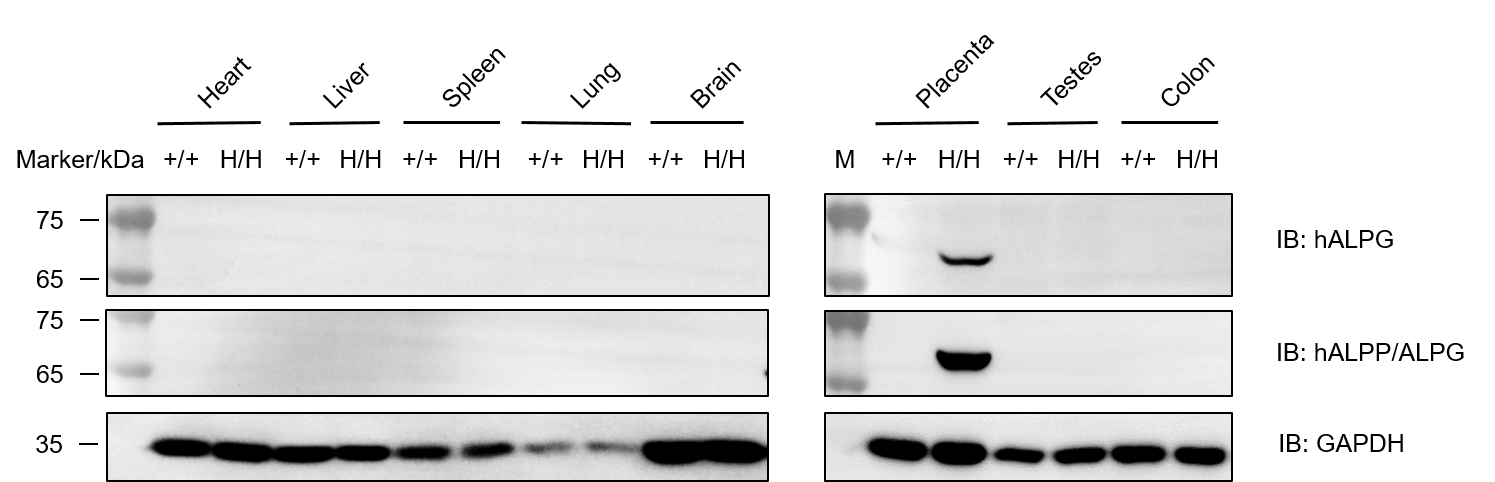
      Protein Expression Analysis in Humanized B-hALPG/hALPP mice

      Western blot analysis of ALPG and ALPP protein expression in homozygous B-hALPG/hALPP mice. Various tissue lysates were collected from wild-type C57BL/6JNifdc mice (+/+) and homozygous B-hALPG/hALPP mice (H/H), and then analyzed by western blot with anti-ALPG antibody (Proteintech, 84813-1-RR) and anti-human ALPP/ALPG antibody (abcam, ab133602). 40 μg total proteins were loaded for western blotting analysis. GAPDH was detected as an internal control. Human ALPG and ALPP protein were exclusively detectable in placenta from homozygous B-hALPG/hALPP mice, but not from wild-type C57BL/6JNifdc mice. M, marker.

      * When publishing results obtained using this animal model, please acknowledge the source as follows: The animal model [B-hALPG/hALPP mice] (Cat# 113748) was purchased from Biocytogen.